


Email marketing is still one of the highest-ROI channels, and the global email marketing software market is projected to nearly double to around USD 3.7 billion by 2032 as businesses lean into automation and AI-driven personalization. If you started with Benchmark, you may now be hitting limits around advanced workflows, omnichannel campaigns, or scalability and are actively searching for the best Benchmark alternatives.
This guide walks through 11 top Benchmark alternatives, covering short descriptions, standout features, pros and cons, pricing, and what each tool is best for. It is designed for business owners, marketers, and freelancers who want a practical, side‑by‑side view of each Benchmark substitute before committing. The goal is to save hours of research and help you move quickly from “Which tool should I use?” to “Let’s launch our next campaign.”
What Is Benchmark and Why Look for Alternatives?
Benchmark is a user‑friendly email marketing platform focused on simple campaign creation, list management, and basic automation for small businesses. It offers a drag‑and‑drop editor, responsive templates, analytics, and a free plan that typically covers up to 500 contacts and 3,500 emails per month.
Users often start searching for a Benchmark alternate when they need deeper automation, more storage, advanced segmentation, or integrated CRM and ecommerce tools. Others look for a Benchmark substitute to improve deliverability, reduce costs at higher volumes, or consolidate channels like SMS, push notifications, and social ads into one platform.
Benchmark Alternatives
Benchmark alternatives are email marketing platforms that offer similar or expanded features such as drag‑and‑drop editors, automation, segmentation, and analytics, often with stronger CRM or omnichannel capabilities. Leading Benchmark alternatives in 2026 include Mailchimp, Brevo, Constant Contact, MailerLite, GetResponse, HubSpot, SendX, Moosend, Omnisend, ActiveCampaign, and NotifyVisitors, each catering to different budgets and complexity needs.
Best Benchmark Alternatives in 2026





Mailchimp
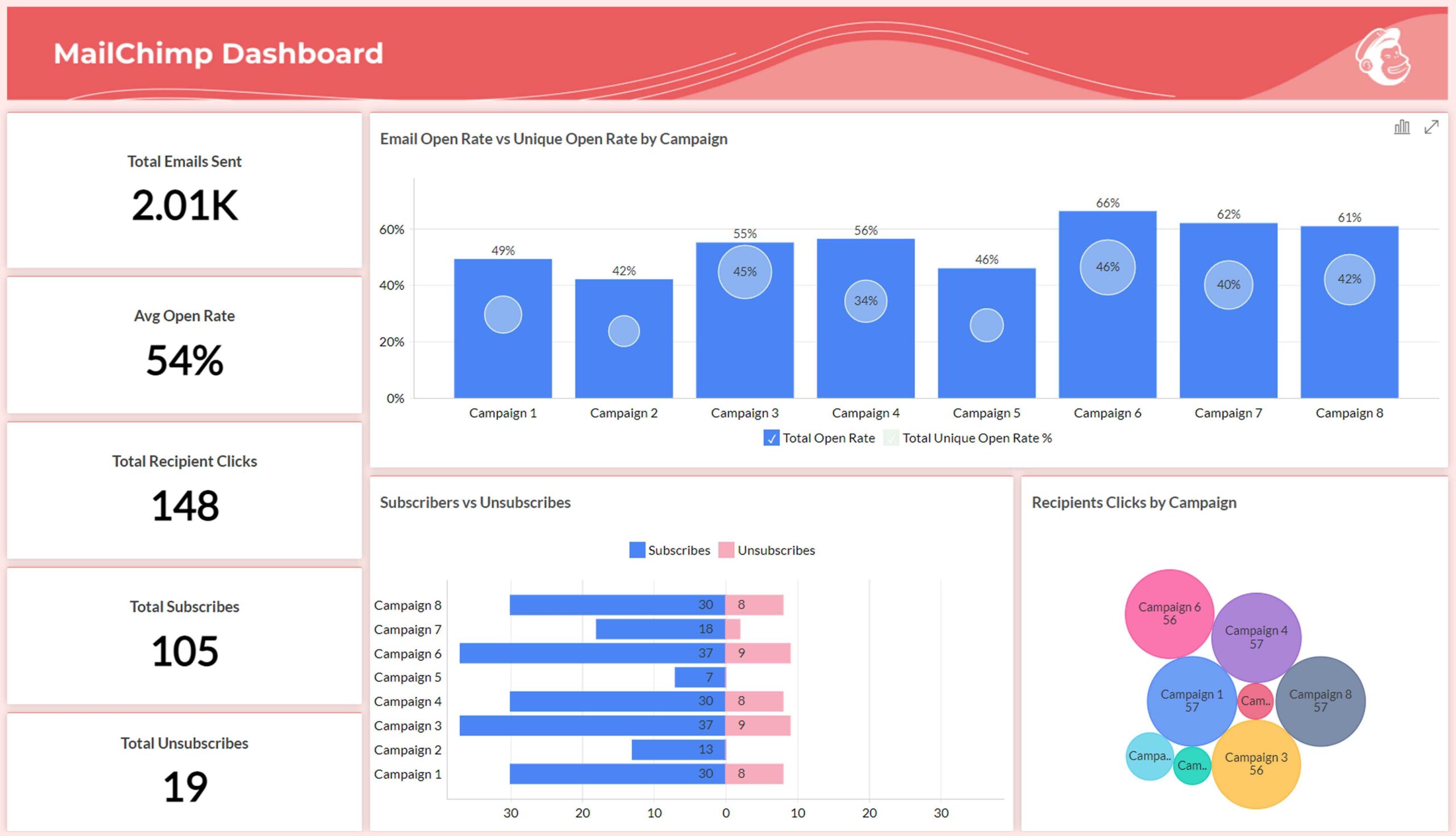
Mailchimp is an all‑in‑one marketing platform that evolved from email into a broader suite covering automation, basic CRM, landing pages, and multichannel campaigns.
Key features
- Drag‑and‑drop email builder with extensive templates.
- Advanced automation with branching logic and journeys.
- Built‑in CRM, audience segments, and predictive insights.
- Landing pages, forms, and basic ecommerce integrations.
- Powerful automation and segmentation for growing brands.
- Rich ecosystem of integrations and third‑party apps.
- Suitable as a central hub for marketing, not just email.
- Pricing can ramp up quickly as lists grow.
- Interface and feature set can feel heavy for very small teams.
Pricing (indicative)
- Free tier with limited contacts and sends for small lists.
- Paid plans generally start around the low double‑digit USD/month range and scale by contacts and features.
Best for
- Small to mid‑size businesses wanting a Benchmark substitute that also acts as a light CRM and marketing automation hub.
Brevo
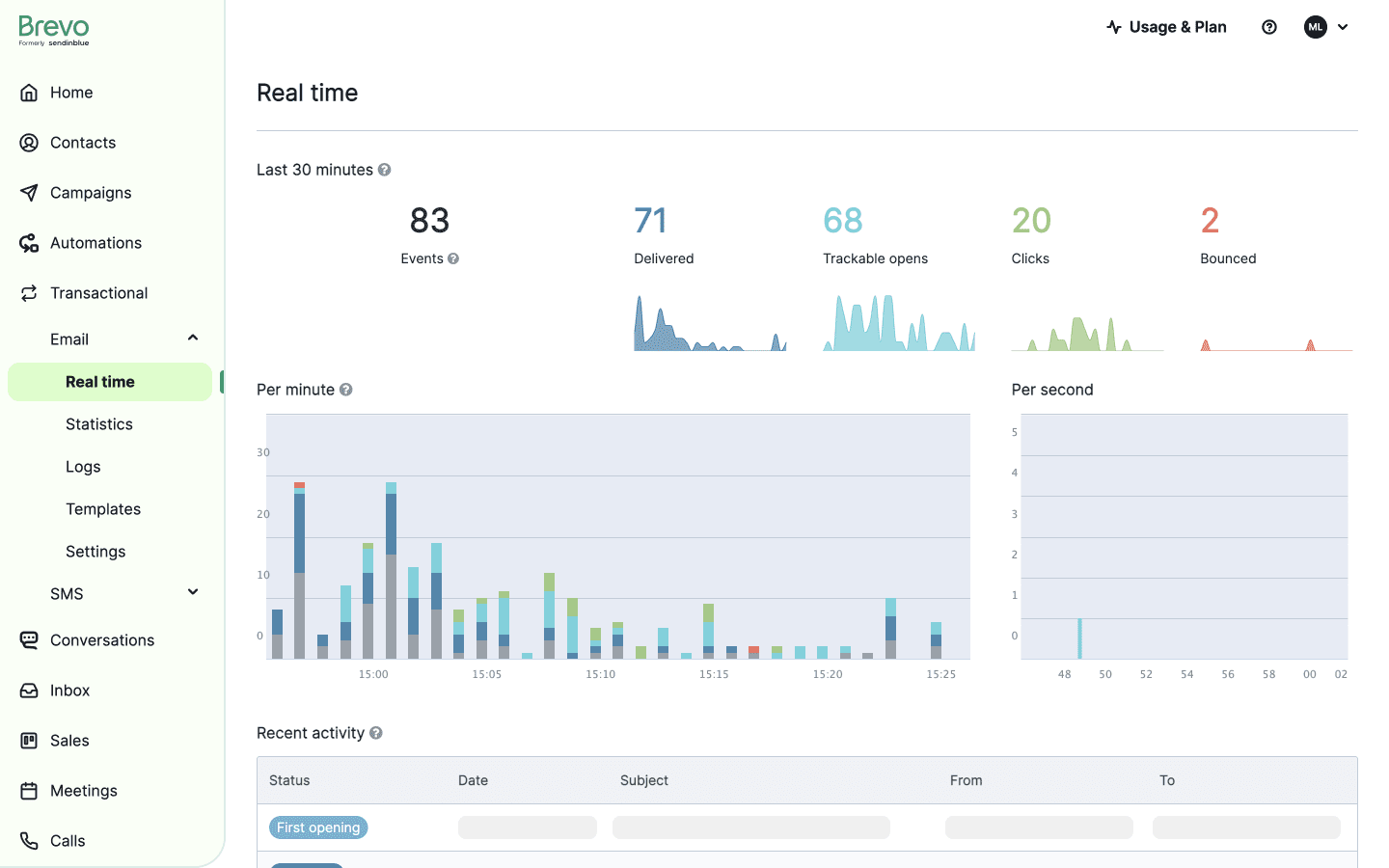
Brevo is an email and SMS marketing platform with strong transactional email capabilities and an attractive entry‑level pricing model.
Key features
- Email campaigns, SMS, WhatsApp, and transactional emails.
- Marketing automation workflows and segmentation.
- Shared inbox and simple CRM tools.
- Channel mix goes beyond email, ideal for lifecycle messaging.
- Competitive pricing with generous send‑based plans.
- Good option for SaaS, ecommerce, and transactional use cases.
- Automation UI can feel less polished than specialized tools.
- Some advanced features locked behind higher tiers.
Pricing (indicative)
- Free tier with limited emails per day.
- Paid plans start in the low double‑digit USD/month range based on email volume rather than contacts.
Best for
- Businesses needing a Benchmark substitute with strong transactional email and multi‑channel messaging on a budget.
MailerLite
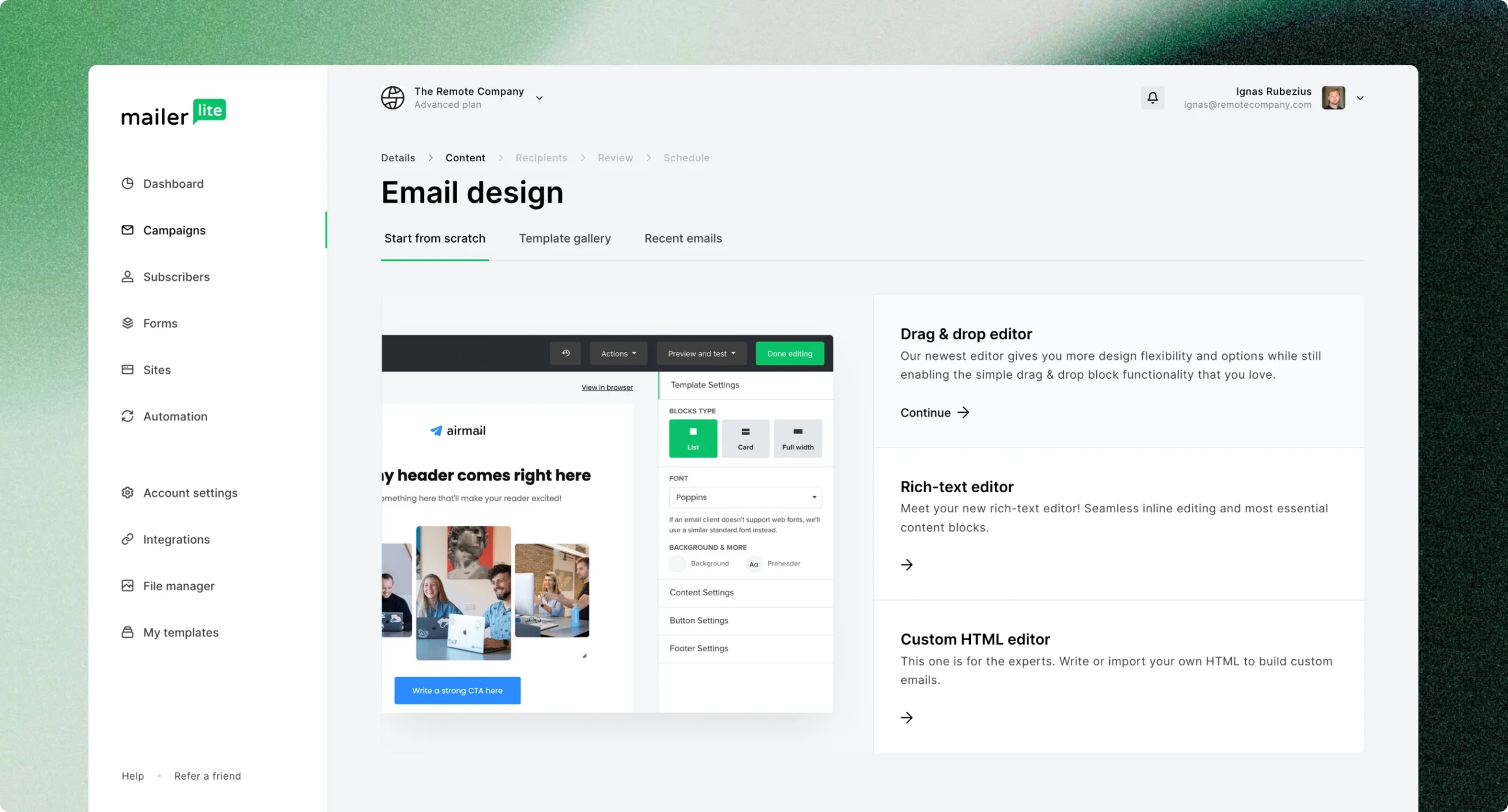
MailerLite is a clean, minimalist email marketing platform known for ease of use and good value for startups, creators, and small businesses.
Key features
- Drag‑and‑drop editor, newsletters, and automations.
- Landing pages, websites, and signup forms.
- Integrations with popular ecommerce and creator tools.
- Very intuitive interface with a short learning curve.
- Competitive pricing and generous free tier for small lists.
- Good deliverability and template quality for the price.
- Automation and CRM depth more limited than enterprise tools.
- Some advanced features only on higher‑tier plans.
Pricing (indicative)
- Free plan with limited contacts and monthly sends.
- Paid plans usually start in the low double‑digit USD/month range depending on list size.
Best for
- Freelancers, creators, and early‑stage startups seeking a lightweight Benchmark substitute that stays simple.
GetResponse

GetResponse is an email and marketing automation platform that adds webinars, funnels, and conversion‑focused tools on top of standard email campaigns.
Key features
- Email marketing, automation workflows, and segmentation.
- Webinars, sales funnels, and landing pages.
- Ecommerce integrations and product recommendations.
- Strong toolkit for funnels and webinars in one platform.
- Good for info‑products, coaching, and ecommerce brands.
- Flexible automation builder for drip and behavior‑based flows.
- Interface can feel complex for simple newsletter use cases.
- Webinars and advanced features reserved for higher plans.
Pricing (indicative)
- Entry plans in the low‑to‑mid double‑digit USD/month range for smaller lists.
Best for
- Marketers needing a Benchmark alternate that bundles email with webinars, funnels, and ecommerce promotions.
HubSpot Marketing Hub

HubSpot Marketing Hub is a robust inbound marketing platform with enterprise‑grade email, automation, CRM, and content tools in one ecosystem.
Key features
- Full CRM, marketing automation, email, and lead scoring.
- Blog, landing page, and CMS capabilities.
- Powerful reporting and attribution dashboards.
- Deep integration between CRM, email, and content marketing.
- Strong fit for B2B pipelines and complex journeys.
- Scalable from startup to mid‑market and beyond.
- Pricing grows significantly as contacts and hubs expand.
- Overkill for simple newsletter‑only needs versus lighter Benchmark substitutes.
Pricing (indicative)
- Free tools for basic CRM and email.
- Paid Marketing Hub tiers climb from low triple‑digit USD/month into higher tiers for scaling teams.
Best for
- B2B companies wanting to replace Benchmark with a full inbound marketing and CRM platform
Benchmark vs Leading Alternatives: Comparison Table
High‑Level Benchmark Alternatives Snapshot
| Tool | Core Focus | Automation Depth | Channels (beyond email) | Best For |
| Benchmark | Simple email campaigns. | Basic | Email only | Small businesses starting out |
| Mailchimp | All‑in‑one SMB marketing | Advanced | Email, web, ads, postcards | Growing SMBs, light CRM |
| Brevo | Email + transactional + SMS | Moderate | Email, SMS, WhatsApp | Budget‑conscious multichannel |
| MailerLite | Simple, value‑driven email | Moderate | Email, sites, landing pages | Creators, small teams |
| GetResponse | Funnels & webinars | Advanced | Email, webinars, pages | Info‑products, ecommerce |
| HubSpot | Full inbound suite | Advanced | Email, CRM, content | B2B teams needing one hub |
*Pricing is indicative and varies by contacts, features, and region; check live details via Toollers.com and vendor sites.
How to Choose the Right Benchmark Substitute
When benchmarking alternatives, anchor on your primary use case and growth horizon rather than just today’s list size. The email marketing software market is growing at double‑digit CAGR, and most tools are layering on AI and automation, so consider where your strategy will be in 12–24 months, not just now.
Use this quick checklist before deciding:
- If you want an all‑in‑one Benchmark alternate with CRM: shortlist Mailchimp, HubSpot, or ActiveCampaign.
- If you prioritize omnichannel (email + SMS + push/WhatsApp): look at Brevo, Omnisend, or NotifyVisitors.
- If budget and simplicity matter most: compare MailerLite, Moosend, and SendX against Benchmark’s current plan.
- If webinars and funnels are central: GetResponse often beats a simple email‑only stack.
Common Mistakes & Myths
| Myth | Reality |
| All email tools have the same deliverability. | In reality, infrastructure, IP reputation, and list hygiene tools vary widely, which is why some users move off Benchmark in search of better inbox placement. |
| Migrating without cleaning your list. | Moving bounced or inactive contacts into your new Benchmark substitute can harm sender score and slow ramp‑up. |
| More features always mean better results. | Over‑buying complex marketing suites like HubSpot or ActiveCampaign without internal capacity often leads to underused automation and wasted spend. |
| Ignoring total cost at scale. | Some tools look cheap at 1,000 contacts but become significantly pricier than Benchmark at 20,000+. Always model 12–24 month growth. |
Conclusion
Benchmark is a solid entry‑level email platform, but the rapid growth of the email marketing software market means there are now many Benchmark alternatives that deliver richer automation, deeper CRM integration, and true omnichannel journeys. Whether you choose Mailchimp, Brevo, ActiveCampaign, Omnisend, or another Benchmark substitute, the right fit hinges on your channels, list growth, and internal capacity.
FAQs
1.Why switch from Benchmark to another email marketing tool?
Most users look for a Benchmark alternative when they need stronger automation, omnichannel messaging, built‑in CRM, or more storage than Benchmark’s current plans provide. Others move to cut costs at higher volumes, or to consolidate several point solutions into a single platform.
2. What is the best Benchmark alternate for small businesses?
For many small businesses, MailerLite, Brevo, and Constant Contact are popular Benchmark substitutes because they blend ease of use with reasonable pricing and solid templates. The “best” choice depends on whether you value more channels (Brevo), stronger support (Constant Contact), or a minimalist interface (MailerLite)
3. Which Benchmark alternative is best for ecommerce?
Ecommerce brands often prefer Omnisend, Moosend, or GetResponse because of their ecommerce‑specific automations like cart recovery, product recommendations, and revenue attribution. These platforms usually integrate tightly with Shopify, WooCommerce, and similar carts, which Benchmark covers more lightly.
4. Is Mailchimp better than Benchmark?
Mailchimp generally offers broader features—such as CRM, more sophisticated automation, and additional channels—while Benchmark focuses on simplicity and core email campaigns. Mailchimp is often a better Benchmark substitute for growing teams, but it may also be more expensive and complex for basic newsletter use.
5. What’s the most budget‑friendly Benchmark substitute?
Brevo, MailerLite, SendX, and Moosend tend to be among the most cost‑effective, especially for smaller lists and value‑driven users. However, the cheapest option can change quickly with promotions and list growth, so always confirm current pricing through Toollers and vendor pages.
6. How do I migrate from Benchmark to a new platform?
Typically you export your lists and fields from Benchmark, clean them, and then import into your chosen Benchmark alternate before rebuilding core automations and templates. Many providers offer migration guides or support to help with this process, especially for larger accounts.
