
Live chat isn’t optional anymore: recent industry reports show that most customers now expect real‑time support on websites and in‑app experiences, and businesses that offer fast chat responses see higher satisfaction and conversion rates. At the same time, many teams feel boxed in by Livechat’s per‑agent pricing, separate chatbot costs, and limited flexibility as they add more channels and automation.
This guide walks through the 5 best Livechat alternatives in 2026—Tidio, Intercom, Zendesk Suite, LiveAgent, and Tawk.to—so you can quickly compare features, pros and cons, pricing, and “best for” scenarios. Whether you’re a solo founder, a growing SaaS, or a support‑heavy team, you’ll find at least one Livechat substitute that delivers better value, deeper AI, or broader omnichannel capabilities.

Why consider a Livechat alternatives?
Teams usually go looking for a Livechat alternative when pricing, missing channels, or lack of automation starts blocking growth. Many modern platforms now bundle AI chatbots, omnichannel inboxes, and ticketing into one tool, often at a lower total cost for small and mid‑size businesses.
In 2025–2026, several reports show strong adoption of AI support agents, with tools like Intercom, Zendesk, and Tidio using AI to resolve a large share of repetitive tickets before humans get involved. If Livechat feels like “just a chat box”, switching to a more complete Livechat substitute can free up agents, improve response times, and give you better analytics.
How to choose the right Livechat substitute
Before comparing tools, clarify what you actually need from a Livechat alternate. For many smaller businesses, the true requirement is “fast, simple chat plus basic automation”; for larger teams, it’s “AI, ticketing, and omnichannel reporting”.
Key Features
- Channels: Web chat, in‑app, email, social, WhatsApp, SMS.
- Automation: AI chatbots, routing, triggers, workflows.
- Support model: Pure chat vs full help desk with tickets and SLAs.
- Pricing model: Per agent, per workspace, or usage‑based.
Livechat Alternatives
What is the best Livechat alternative in 2026?
The best Livechat alternative depends on your needs: Tidio for affordable AI chat, Intercom for advanced in‑app experiences, Zendesk Suite for enterprise ticketing, LiveAgent for value‑packed omnichannel support, and Tawk.to for a completely free Livechat substitute. Compare pricing, channels, and automation before switching.
5 best Livechat Alternatives in 2026



Below are 5 carefully selected Livechat alternatives with short description, features, pros, cons, pricing, and “best for” in clear points.
1. Tidio

Tidio is a popular Livechat substitute for small businesses and online stores thanks to its mix of live chat, AI chatbots, and wallet‑friendly pricing. AI‑powered customer service platform that blends live chat, chatbot automation, and multichannel support into one dashboard.
Key Features
- Live chat widget with modern UI for websites and e‑commerce stores.
- “Lyro” AI agent that can automate a large share of customer questions.
- Visual chatbot flows for lead capture, abandoned cart recovery, and FAQs.
- Shared inbox across chat, email, and social integrations.
- Easy to set up and intuitive for non‑technical teams.
- Generous free plan and affordable paid tiers compared with many competitors.
- Strong AI and automation capabilities included even for smaller users.
- Some advanced support workflows (voice, complex routing) are limited compared with enterprise suites.
- Conversation or contact limits may apply on lower tiers, which can require upgrades as volume grows.
Pricing (Indicative)
- Paid plans start around the mid‑$20s per month per agent or workspace, with higher tiers for larger teams and advanced features; there is also a free plan with limited usage.
Best For
- Small businesses, freelancers, and e‑commerce brands needing a Livechat alternative that combines chat and AI without enterprise‑level pricing.
2. Intercom

Intercom is a premium Livechat alternate built for SaaS and product‑led companies that want in‑app messaging, AI agents, and lifecycle automation. Customer communications platform with AI agents, a unified inbox, and rich in‑app experiences for onboarding, support, and engagement.
Key Features
- AI agent “Fin” to answer questions from your help center and docs.
- Multi‑channel inbox (in‑app chat, email, and more).
- Behavioral targeting and customer segmentation for proactive messages.
- Product tours, announcements, and banners for in‑app onboarding.
- Extremely strong automation and personalization capabilities.
- Works across marketing, sales, and support, not just chat.
- Deep ecosystem of integrations with other SaaS tools.
- Pricing is higher than most SMB‑focused Livechat substitutes.
- Steeper learning curve; can feel heavy for tiny teams.
Pricing (Indicative)
- Tiered plans starting around the high‑$20s per seat/month, with advanced and enterprise tiers significantly higher depending on contacts and features.
Best For
- SaaS and B2B companies that want a Livechat alternative with powerful AI, in‑app engagement, and cross‑team use cases.
3. Zendesk Suite (with Messaging)

Zendesk Suite is a full customer service platform where live chat is just one of many channels inside a robust ticketing and analytics environment. Omnichannel help desk that combines chat, email, social, and voice with ticketing, knowledge base, and AI‑powered self‑service.
Key Features
- Unified agent workspace with chat‑to‑ticket flows.
- AI tools for suggested answers, routing, and self‑service.
- Knowledge base and help center tightly integrated with tickets.
- Advanced analytics, SLAs, and role‑based access for larger teams.
- Excellent fit for structured support teams with high ticket volume.
- Very strong reporting and enterprise‑grade security.
- Large ecosystem of apps and integrations.
- Overkill if you only need a lightweight Livechat substitute.
- Suite pricing can be relatively expensive for micro teams.
Pricing (Indicative)
- Zendesk Suite plans often start from around the mid‑$50s per agent/month, increasing for growth and enterprise tiers with more advanced capabilities.
Best For
- Established support organizations that want to replace Livechat with an end‑to‑end ticketing and omnichannel solution.
4. LiveAgent
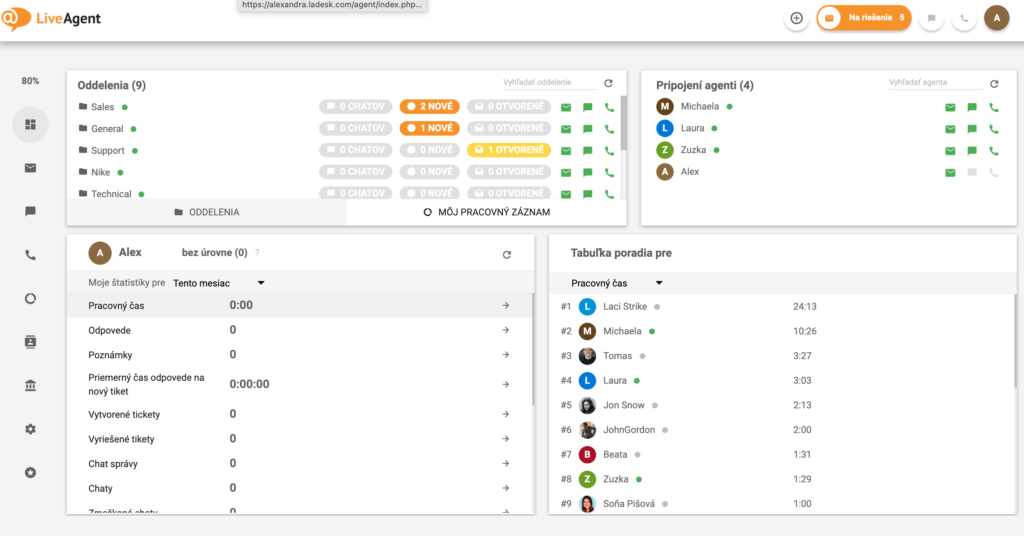
LiveAgent is a value‑packed Livechat alternative that bundles chat, email, social, and even voice in a single help desk platform. All‑in‑one support solution offering live chat, ticketing, social integrations, and call center features.
Key Features
- Omnichannel ticketing from chat, email, and social media.
- Built‑in call center with phone and video support.
- Gamification and productivity tools for agents.
- Knowledge base and customer portal capabilities.
- Very competitive pricing given the breadth of features.
- Good choice for teams that want phone + chat in one place.
- Mature feature set for routing, SLAs, and reporting.
- Interface may feel less modern than newer, chat‑only tools.
- Setup and configuration can be more involved at first.
Pricing (Indicative)
- Paid plans typically start in the mid‑teens per agent/month, scaling with additional channels and advanced options.
Best For
- Support teams that need a Livechat alternate covering chat, email, and phone at a reasonable cost.
5. Tawk.to

Tawk.to is the go‑to free Livechat alternative for startups and small businesses that need basic live chat without software costs. Free live chat tool with unlimited agents, optional paid add‑ons for branding removal and outsourced agents.
Key Features
- Website chat widget and visitor monitoring.
- Basic ticketing and knowledge base add‑ons.
- Simple automation and canned responses.
- Marketplace for hiring chat agents as a service.
- $0 software cost for the core product with generous limits.
- Quick to install and easy to use.
- Good starting point for testing whether live chat moves the needle.
- Tawk.to branding unless you pay to remove it.
- Fewer advanced AI and enterprise features than premium tools.
Pricing (Indicative)
- Core platform is free; you pay extra only for removing branding or for outsourced agents and some add‑ons.
Best For
- Bootstrapped startups, freelancers, and very small businesses that want a free Livechat substitute to validate chat before investing.
Comparison table: Livechat vs top alternatives
| Tool | Core Focus | Key Strength vs Livechat | Best For |
| Livechat | Web live chat & support | Mature live chat with many integrations | General SMB support |
| Tidio | AI chat + SMB/e‑commerce | Affordable AI and easy setup | Small businesses & online stores |
| Intercom | AI + in‑app engagement | Powerful automation and product messaging | SaaS & product‑led teams |
| Zendesk Suite | Full help desk + messaging | Enterprise ticketing, analytics, and governance | Structured support organizations |
| LiveAgent | Omnichannel help desk | Many channels at good value | Multi‑channel support teams |
| Tawk.to | Free live chat | Zero software cost, optional outsourced agents | Startups and micro‑businesses |
Common mistakes & myths
Only comparing headline prices. Teams often compare “per agent” costs but forget about chatbot usage limits, add‑ons, or required suite upgrades, which can change the real monthly bill.
| Myth | Reality |
| Ignoring automation limits. | Some Livechat alternatives cap AI or chatbot conversations on lower tiers, which can lead to unexpected overages or forced upgrades as volume spikes. |
| Over‑buying features. | Choosing a full enterprise suite like Zendesk when you only need simple chat can make a migration feel more expensive than staying on Livechat. |
| Not professional enough. | platforms like Tawk.to now power many small businesses and offer upgrade paths if you need branding control or outsourced agents. |
Localized & “near me” use cases
For local businesses—plumbers, clinics, salons, agencies—Livechat alternatives that support SMS, WhatsApp, and Google Business Profile messaging tend to drive more value than purely in‑app chat. Visitors often search “service near me”, then want quick answers by text rather than staying on a website.
In this context, combining a Livechat substitute like Tidio or Tawk.to with messaging‑oriented platforms or lead capture tools works well, especially when agents primarily respond from mobile devices. Prioritize mobile apps, SMS integrations, and simple routing over complex in‑app tours or heavy product analytics.
Conclusion & next steps
Choosing the right Livechat alternative is less about chasing the “most powerful” platform and more about aligning chat, channels, and automation with how your team actually works. If you want a simple, affordable Livechat substitute, Tidio and Tawk.to are excellent starting points; if you need deep AI, ticketing, and omnichannel analytics, then Intercom, Zendesk Suite, or LiveAgent will likely fit better.
Start by listing your must‑have channels, daily ticket volumes, and budget, then shortlist two or three tools from this article and test them via free trials or pilots. Track response times, automation coverage, and conversions so you can confidently pick the Livechat substitute that delivers both better customer experience and clear ROI.
FAQs
1. What is the best Livechat alternative for small businesses?
For most small businesses, Tidio, LiveAgent, and Tawk.to are strong candidates because they balance features with accessible pricing. Tidio adds AI and e‑commerce focus, LiveAgent covers multiple channels at good value, and Tawk.to gives you a free Livechat substitute to test before spending.
2. Which Livechat substitute offers the most AI automation?
Intercom, Zendesk Suite, and Tidio currently stand out for AI automation, from answering FAQs to suggesting replies and routing tickets. Intercom’s Fin agent and Zendesk’s AI features focus heavily on deflection and agent efficiency, while Tidio’s Lyro automates many repetitive chat interactions at SMB‑friendly prices.
3. Is there a completely free alternative to Livechat?
Yes. Tawk.to is a fully free Livechat alternative with unlimited agents, while several other tools offer freemium tiers with usage limits. Free plans are ideal for early‑stage businesses, but you should plan for a potential upgrade if you outgrow feature or branding constraints.
4. How hard is it to migrate from Livechat to one of these tools?
Migration is usually straightforward: add the new widget code to your site, configure key triggers and bots, test in parallel for a short period, then remove the Livechat script once you’re satisfied. Some platforms also provide import tools or onboarding specialists to help you move settings and FAQs.
5. Which Livechat alternate is best for SaaS and product‑led growth?
Intercom and Zendesk Suite are particularly strong for SaaS and product‑led teams that need in‑app messaging, rich data, and tight integration with existing tools. Tidio can also work for smaller SaaS teams that want AI chat with a lighter price point and simpler setup.
6. Can switching Livechat alternatives improve conversion rates?
Yes, especially if you combine targeted chat prompts, automated FAQs, and proactive outreach on high‑intent pages. Many case studies show that well‑configured chat and AI can reduce friction at checkout or demo booking steps, increasing overall conversion rates compared with passive contact forms.
